Just don't call it pot
David Dias, Financial Post Magazine
Published: Tuesday, October 07, 2008
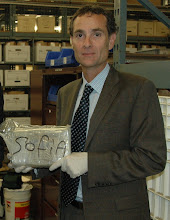
If you let your mind wander a bit, you might almost think you're waiting in line at an upscale coffee shop. You're not, of course. This is the Montreal lab of a Toronto-headquartered junior drug developer called Cannasat Therapeutics Inc. But the white-coated lab technician looks sort of like a barista, and the machine she's operating, known as a tablet press, resembles a milk steamer. The technician pours a few small packets of talc-like powder into a hole in the metal base of the press. It comes to life as she pulls on a lever, with a nearby computer screen flashing assorted data as the press does its work. After a moment, she lets go of the lever, and four thin tablets tumble onto an aluminum plate, which the technician presents like a tray of hors d'oeuvres to a pair of men standing nearby. Cannasat CEO David Hill and Umar Syed, Cannasat's chief scientific officer, both reach for tablets, briefly discussing where best to let them dissolve in their mouths. Under the tongue? Towards the back? They decide to insert them along their gum lines. And in they go.
If these pills were real medications, rather than blanks containing no active ingredients, Hill and Syed would, over the next 15 minutes, receive a dose of a compound that shows great promise in treating ailments ranging from neuropathic pain - caused by nerve damage related to afflictions such as cancer, HIV and arthritis - to psychiatric disorders including anxiety and schizophrenia. Combined, these conditions, and related ailments, afflict 2% of the world's population, creating a potential market worth billions of dollars if this Toronto-based junior pharma can turn its up-and-coming science into a blockbuster drug. But the hurdles in the pharmaceutical industry are high, with scientific research and clinical testing consuming millions of dollars and years of time just to reach the point where a small firm like Cannasat can start shopping for investment from the Pfizers and Bayers of this world to continue research and development. And Cannasat faces barriers even more formidable, due to the stigma surrounding the plant that has inspired its research: cannabis sativa, aka marijuana.
It's almost as though all the studies produced over the past 20 years supporting the use of marijuana in medicine - or more precisely its psychoactive ingredient, tetrahydrocannabinol - had never been read or believed. Proudly tell the world that you're in the business of distributing medical marijuana and that you're developing THC-based drugs - as Cannasat did when it first went public on the TSX Venture Exchange in 2006 - and people either start cracking stoner jokes or start warning you that you're undercutting your chances of winning regulatory approval.
"You learn your lessons the hard way," Hill says, philosophically. "If I were to do this again today, I would have been all about the diseases we were going after."
That might have been a good idea. Today, Cannasat's stock is stuck at 20¢, having barely budged since an initial pop - and equally prompt retreat - following its IPO. Even though the company has invested almost $10 million in research and is the only firm in Canada devoted to the development of cannabinoid drugs, it has, in recent months, been preoccupied with scrubbing its profile of any connections to marijuana. It has sold off its interests in cultivating and distributing medical pot. It has pumped up its board with distinguished members of the Canadian medical establishment, and dropped the word marijuana from its lexicon, instead describing its research in terms of specific molecules and chemical reactions in the brain. More significantly, its leading drug prospect - a neuropathic pain treatment code-named CAT 310 - technically doesn't have any marijuana in it at all. Instead, it uses a man-made version of THC called dronabinol, which has already been approved for use in other pharmaceuticals. Furthermore, the company's pitch to potential investors regarding CAT 310 focuses on its innovative delivery mechanism (hence the pill demonstration) that Cannasat claims will make its version of the drug easier to take and more effective, with fewer side effects - a proven pharmaceutical repackaging strategy that made billions for Biovail Corp. during its heyday.
For all the efforts Hill has made to dissociate Cannasat from its marijuana roots, however, his most pressing concern comes down to sheer survival. Cannasat is now running out of money. To stay alive, Hill will have to issue new equity on public markets before the end of next year. If he can boost his firm's share price by then - hopefully with the release of positive results from CAT 310 clinical trials scheduled to begin in January - he stands a good chance of finding the money he needs. If not, this could be the end of the line for Cannasat and all of Hill's efforts to put its most acceptable face forward. "I've got one more year to hit my home run," he says.
IN PERSON, HILL is cheerful and high-spirited. Seated at a boardroom table in Cannasat's lab, he brims with enthusiasm as he runs through the slide presentation he's been out showing to investors, tapping firmly at the screen of an open laptop as he points out the most impressive stats. Forty billion, for instance. That's the number of dollars up for grabs in the North American market for pain, anxiety and mood disorders - the very markets Cannasat is targeting with its treatments.
It's a massive opportunity, he says. Of course, with that kind of money on the table, Cannasat faces international competitors in the field of cannabinoid drugs. Research showing the potential for cannabis-based drugs has been trickling into pharmaceutical labs since the 1980s, and the scientific community has long been convinced of their usefulness as pain-relievers and appetite stimulants. Meanwhile, industry experts say that major pharmaceutical firms such as Bayer and Sanofi-Aventis have all quietly entered the space with their own cannabinoid platforms. They're watching closely as junior companies like Cannasat and its main competitor, U.K.-based GW Pharmaceuticals, develop the first mainstream drugs based on cannabis derivatives or synthetic versions of THC. For this reason, Hill may yet have time to hit his home run and make good on the promise and optimism that was evident when Hill and Lorne Gertner - his partner in his other business, a Toronto-based merchant bank - founded Cannasat in early 2004. The duo came up with their idea shortly after a series a court challenges that led to the legalization of medical marijuana in Canada and Health Canada had announced its decision to award an exclusive contract to Prairie Plant Systems to grow the nation's first legal supply. Sensing an opportunity, the duo approached Moses Znaimer - a co-founder of the CITY TV television stations, and later the visionary behind such specialty channels as MuchMusic - and clothing icon Joseph Mimran, one of the founders of the Club Monaco chain. Their plan was to form a new medical marijuana company based on a two-pronged strategy. First, they would approach Prairie Plant Systems with an offer to buy a stake in the firm. Then, they would use Znaimer's and Mimran's celebrity to spread awareness of medical marijuana's availability. As the market grew, cash that flowed to the firm from Prairie Plant would then be funneled into marijuana-based drug development.
The first part of the plan went off without a hitch. Znaimer and Mimran signed on, and the following summer, Prairie Plant Systems agreed to sell Cannasat a stake in the company for $1.6 million. Next, Cannasat raised $6.5 million from high-net-worth investors and hired key company personnel. But the good times would not last for much longer. Things started to go wrong for Cannasat when it went public in April 2006, waving the marijuana flag with gusto. Hill ruefully recalls the company's coming-out party. Znaimer, then company chairman, called a press conference to promote the newly listed stock. Reporters from all the major dailies were awestruck as the media mogul - with a bag of pot casually resting at his side - introduced Cannasat and outlined its strategy of supplying medical marijuana while developing cannabis-based drugs. At one point during the conference, one reporter asked about Cannasat's forthcoming product, "Does it give you a buzz?" The rest tried not to smirk as Znaimer sternly responded, "This is not about fun, it's about function." But his admonishment rang hollow. After all, the man is the epitome of boomer bohemianism. Regardless of any opinions Znaimer might have towards recreational pot use, his public profile was hardly one people would immediately associate with sober research.
But the press conference nevertheless served its purpose, and for a brief moment, investors shared Cannasat's enthusiasm, quickly bidding up the company's shares to 65¢, more than triple their opening price. Within days, however, the bloom had come off the rose, and Cannasat's stock was in a severe slide.
Three weeks later, the FDA issued a brief press release claiming that, despite years of scientific research to the contrary, there was no medical benefit to be derived from smoking marijuana. The general condemnation of the drug was a blow to Cannasat. Things got worse when FDA staff began warning the company that its future as a legitimate pharmaceutical firm could be in jeopardy so long as it clung to its image as an all-purpose marijuana company.
By early 2007, Hill decided what would have to be done. The company would have to start from scratch, shaking off any connection to medical marijuana and becoming a pure-play pharmaceutical firm. Immediately, he began to assemble a group of eminent directors to give Cannasat the credibility it needed. Znaimer graciously stepped down as chairman to make way for Dr. David Pattenden, former CEO of the Ontario Medical Association. Seven months later, Dr. Julia Levy joined the board, bringing her track record as the founder of Vancouver-based biotech QLT Inc., maker of the hit anti-blindness drug, Visudyne. Then, this past summer, Cannasat sold its stake in Prairie Plant, breaking even on the deal.
BACK IN CANNASAT'S lab, chief scientific officer Umar Syed is enthusiastically talking about CAT 310. The drug, he says, was designed with the stigma of cannabinoid-based drugs in mind. At the same time, he believes the company will get more mileage from the potential of the delivery mechanism, known as "nano-encapsulation," which Cannasat is using under license from the Finnish university researchers who developed it.
If CAT 310 clears its trials, its dissolving pill formulation will be key to its ability to compete with a dronabinol drug already on the market - an oral spray produced by GW Pharmaceuticals. So far, reception to GW's spray has been mixed. Patients have had a hard time with the bitter taste and tar-like texture of the fluid and often swallow it before it has a chance to be absorbed through the mouth. Furthermore, the digestive process in the stomach converts the dronabinol into a metabolite that has no analgesic properties but still retains side effects associated with cannabinoids - dizziness, sleepiness and the risk of paranoia. In other words, they get high and then have to take more of the oral spray to achieve pain relief.
By contrast, Cannasat's CAT 310 pill dissolves slowly in the mouth, delivering the drug more efficiently to the bloodstream, says Syed, and patients can take smaller doses, thus reducing unwanted side effects such as intoxication. At least, in theory. At the moment, the "nano-encapsulation" technology Cannasat uses to make the CAT 310 tablets works too well. As the pill dissolves, it encases the dronabinol molecules, preventing enough of them from being absorbed. That issue led to the failure of an earlier attempt to complete Phase I trials for CAT 310. But Syed says that problem can be overcome with a tweaking of the formulation in advance of CAT 310's new set of Phase I trials.
But CAT 310 is only the first step in Cannasat's long-term strategy. The company has another, even bigger, project in the works - a potential ace up its sleeve called CAT 320. The drug is based on a molecule found in cannabis leaves called cannabidiol (CBD) - which has none of the psychoactive properties associated with marijuana - and is showing potential in the treatment of various mood and psychotic disorders including schizophrenia, a huge global market. Syed blurts out the word "gold mine" before checking himself. Still, he insists that the blockbuster potential of cannabidiol is no exaggeration: "It is a complete breakthrough."
Well, maybe. Research on CBD is still in early stages. In 2005, German scientists reported results of a small study involving schizophrenics, during the International Cannabinoid Research Society conference, held in Tampa, Fla., that year. That study showed that CBD, taken four times a day, was as effective as any of the dopamine inhibitors currently on the market for schizophrenia - but without side effects that include rapid weight gain and a muscle rigidity resembling Parkinson's disease. Since dopamine inhibitors are used to treat a variety of psychiatric disorders, Cannasat is now rushing to replicate the German study and reformulate CBD into a once-a-day time-release capsule, which is far easier for mental patients to take. If the company's human trials - scheduled to begin spring of 2009 - prove successful, CAT 320 could ultimately compete with current dopamine drugs and take a substantial chunk of the $15-billion market in North America. "We know we have a winner," says Syed. "We just have to formulate it into a once-a-day."
Other researchers, while perhaps not as enthusiastic as Syed, are at least hopeful. Dr. George Nomikos, a world-leading cannabinoid researcher who has advised Cannasat in the past, says cannabidiol is an experimental substance, and it's not clear how it works to treat schizophrenia. "But the data that are coming in from animal experiments and human clinical trials are extremely encouraging."
For Nomikos, a breakthrough for cannabinoid drugs doesn't hinge on the success of individual products like CAT 310 and CAT 320. Instead, he says it will come when scientists can develop a form of THC - marijuana's most potent and most medically useful compound - that people can take without getting intoxicated. That development is still 15 years off, and Nomikos says that what Cannasat is doing now - reformulating natural compounds or known synthetics to make more efficient drugs - is a logical step. "It makes a lot of sense," he says. "It's a natural progression of what we know, and short-term, this is the right thing to do, trying to take advantage of more favourable formulations."
It's also a lower-risk proposition. According to Paradigm Capital researcher Claude Camiré, there are two factors that investors look at in the biotech sector when determining risk: safety and efficacy. Cannasat already has an advantage on the safety issue with is lead drug, CAT 310. Because the key ingredient, dronabinol, has already been approved for commercial sprays, the company will likely be able to ask Health Canada and the FDA for fast-tracked clinical trials. "As for efficacy," Camiré adds, "we need to prove it with a number of trials."
For the time being, though, Cannasat's upcoming equity issue is the priority. If there's a jackpot moment in the company's future, it will come later, perhaps within 18 months. If Cannasat gets through its Phase I trials in the new year and can clear Phase II trials, it will be able to approach major pharmaceutical firms for marketing deals, which will give it the wherewithal to finance final Phase III trials. Any deal will launch Cannasat's stock skyward.
Since it is working with well-known molecules, there is the risk of competition if Cannasat is cleared to launch its lead drug. In Canada, for instance, Bayer already distributes Sativex, the oral spray produced by Cannasat's rival GW Pharmaceuticals, which has a big head start thanks to the unwavering support it has enjoyed from the British government since being founded in 1997. But Syed isn't fazed - because of the limitations of oral sprays, he says that formulations like Sativex can never have the "same potential efficacy of our lead product, CAT 310." Camiré echoes that sentiment: "Cannasat's key advantage is their formulation." In any event, Camiré says there's plenty of room in the pharma space for cannabis-based drugs. "Look at breast cancer. There are probably 10 drugs approved for that. If both companies come up with differing products, they'll most likely be able to sell both."
Cannasat's last remaining hurdle is the one they've already worked hard to overcome: the market's reluctance to invest in cannabis-based drugs. It may seem trivial, but Cannasat's survival will depend on support from fund managers, and Hill says the company has to do more to convince them that its products will be accepted by regulators. After all, similar drugs have already been approved.
Still, Cannasat has come a long way, and Hill has faced a steep learning curve. He's spent the past four years turning an idea generated by entrepreneurs with no science background into a legitimate pharmaceutical firm. Over that period, he's raised $10 million in dribs and drabs. But that will all change if Cannasat can secure a deal with a major pharma firm.
When that happens, the industry and market will take notice, and Hill dreams of a day when he'll be able to raise $20 million with just a few phone calls in an afternoon. "We've stumbled onto something that has huge potential," he says. "A lot of people have said we're like the little engine that could. We just keep motoring along, and I think we all believe that if we just keep our heads down, we'll get to that point."
http://www.financialpost.com/magazine/story.html?id=850924
Tuesday, October 7, 2008


Pot thefts increase with harvest season
Pot thefts increase with harvest season
Tuesday, October 7, 2008
BY Soumitro Sen
Staff Writer
Three recent marijuana thefts continue to point toward greater crime with the harvesting season underway.
"We are seeing (pot thefts) all over the county," Sgt. Bill Smethers with the Nevada County Narcotics Task Force said. "But no one has been arrested (so far)."
At 1:52 p.m. Friday, a caller from the 23000 block of Highway 49 reported theft of marijuana plants.
At 3:46 a.m. Saturday, a woman from the 13000 block of Clover Leaf Court reported people in her backyard taking medical marijuana.
Six hours later on the 18000 block of Lazy Lane, a woman reported theft of medical marijuana during the night.
People often hesitate to contact law enforcement officers when a theft occurs because "they could have illegal activities that they don't want law enforcement to know of," Smethers said. "Or, perhaps they fear retaliation from those who've stolen from them. ...
"Someone got ripped off down the street from where I live, and it never got reported," Smethers added.
Those who steal the plants often come from out of the area, knowing there's a greater chance of finding marijuana in a rural setting like Nevada County, Smethers said.
In any case, pot plants are more accessible now with people growing medical marijuana openly in their backyards, said Sgt. Doug Wren with the Grass Valley Police Department.
"If you're going to legalize growing marijuana, you're going to find more people who'll want to steal it," Wren added.
"If the weather holds out, (growers) leave the plants out in the open for as long as possible," Smethers said. "If there is morning dew or rain which can cause the plant to mildew, people will harvest them."
The marijuana harvest season typically spans October and early November, Smethers said.
To contact Soumitro Sen, e-mail ssen@theunion.com or call 477-4229.
http://www.theunion.com/article/20081007/NEWS/110079986/1007&parentprofile=1053&title=Pot%20thefts%20increase%20with%20harvest%20season
Tuesday, October 7, 2008
BY Soumitro Sen
Staff Writer
Three recent marijuana thefts continue to point toward greater crime with the harvesting season underway.
"We are seeing (pot thefts) all over the county," Sgt. Bill Smethers with the Nevada County Narcotics Task Force said. "But no one has been arrested (so far)."
At 1:52 p.m. Friday, a caller from the 23000 block of Highway 49 reported theft of marijuana plants.
At 3:46 a.m. Saturday, a woman from the 13000 block of Clover Leaf Court reported people in her backyard taking medical marijuana.
Six hours later on the 18000 block of Lazy Lane, a woman reported theft of medical marijuana during the night.
People often hesitate to contact law enforcement officers when a theft occurs because "they could have illegal activities that they don't want law enforcement to know of," Smethers said. "Or, perhaps they fear retaliation from those who've stolen from them. ...
"Someone got ripped off down the street from where I live, and it never got reported," Smethers added.
Those who steal the plants often come from out of the area, knowing there's a greater chance of finding marijuana in a rural setting like Nevada County, Smethers said.
In any case, pot plants are more accessible now with people growing medical marijuana openly in their backyards, said Sgt. Doug Wren with the Grass Valley Police Department.
"If you're going to legalize growing marijuana, you're going to find more people who'll want to steal it," Wren added.
"If the weather holds out, (growers) leave the plants out in the open for as long as possible," Smethers said. "If there is morning dew or rain which can cause the plant to mildew, people will harvest them."
The marijuana harvest season typically spans October and early November, Smethers said.
To contact Soumitro Sen, e-mail ssen@theunion.com or call 477-4229.
http://www.theunion.com/article/20081007/NEWS/110079986/1007&parentprofile=1053&title=Pot%20thefts%20increase%20with%20harvest%20season
Editorial: With medical pot, rationality goes up in smoke
Editorial: With medical pot, rationality goes up in smoke
Garden Grove latest city to ban medical marijuana outlets based on tortured
reasoning
An Orange County Register editorial
For some reason, the simple issue of medical marijuana brings out the worst
convoluted thinking and even ignorance from those elected officials we rely
upon to make fair-minded and constitutional decisions. Garden Grove is the
latest Orange County city – joining Buena Park, Fullerton, Mission Viejo,
Santa Ana, Tustin, Huntington Beach and Placentia – to ban marijuana
dispensaries in the city. Only Laguna Woods has voted to allow them. The
rationales by council members should be called "irrationales," given how
strained their anti-dispensary arguments seem to be.
In 1996, Californians approved Proposition 215 with a solid 56 percent of
the vote. The initiative was designed to "ensure that seriously ill
Californians have the right to obtain and use marijuana for medical purposes
where that medical use is deemed appropriate and has been recommended by a
physician who has determined that the person's health would benefit from the
use of marijuana in the treatment of cancer, anorexia, AIDS, chronic pain,
spasticity, glaucoma, arthritis, migraine or any other illness for which
marijuana provides relief."
Subsequent state legislation has called for counties to provide ID cards to
people with a justified medical need for marijuana – something the Orange
County Board of Supervisors passed by a 4-1 vote in January. Medical
marijuana is viewed by many in the medical community as having useful
effects for sick people, yet opponents (such as Orange County District
Attorney Tony Rackauckas) try to depict medical-marijuana users as people
who simply want an excuse to use drugs.
But it's not our purpose here to debate the usefulness of this or any other
medicine. We don't typically see politicians angrily insisting that one
narcotic or another dispensed by the local pharmacy works or doesn't work
for any given condition. Those debates should be left to a patient and her
doctor.
The Register reported that, during the Garden Grove debate, Councilwoman
Dina Nguyen argued that the city should not allow medical marijuana
dispensaries because the Police Department is short-staffed. That's an
absurd argument, given that there's no evidence that legal dispensaries
increase crime. And, besides, individual rights are not dependent on the
amount of police resources.
Garden Grove Mayor Bill Dalton said he just didn't like the way marijuana is
dispensed. That's a subjective way to make law. Councilman Steve Jones noted
that the federal government still disputes its legality in California. But
city councils are subdivisions of the state government. And state law is
clear in Prop. 215, even if the feds, thanks to the ongoing drug-war
mentality, have decided to put the Constitution through a shredder.
That's the problem these days. Council members know no limits on their
power. If they don't like something, they want to ban it. Local governments
are, generally, better than the federal government, given that local
officials are closer to the people. But local government can be petty,
hostile to the ideas of limited government and freedom, and amazingly
irrational.
Garden Grove latest city to ban medical marijuana outlets based on tortured
reasoning
An Orange County Register editorial
For some reason, the simple issue of medical marijuana brings out the worst
convoluted thinking and even ignorance from those elected officials we rely
upon to make fair-minded and constitutional decisions. Garden Grove is the
latest Orange County city – joining Buena Park, Fullerton, Mission Viejo,
Santa Ana, Tustin, Huntington Beach and Placentia – to ban marijuana
dispensaries in the city. Only Laguna Woods has voted to allow them. The
rationales by council members should be called "irrationales," given how
strained their anti-dispensary arguments seem to be.
In 1996, Californians approved Proposition 215 with a solid 56 percent of
the vote. The initiative was designed to "ensure that seriously ill
Californians have the right to obtain and use marijuana for medical purposes
where that medical use is deemed appropriate and has been recommended by a
physician who has determined that the person's health would benefit from the
use of marijuana in the treatment of cancer, anorexia, AIDS, chronic pain,
spasticity, glaucoma, arthritis, migraine or any other illness for which
marijuana provides relief."
Subsequent state legislation has called for counties to provide ID cards to
people with a justified medical need for marijuana – something the Orange
County Board of Supervisors passed by a 4-1 vote in January. Medical
marijuana is viewed by many in the medical community as having useful
effects for sick people, yet opponents (such as Orange County District
Attorney Tony Rackauckas) try to depict medical-marijuana users as people
who simply want an excuse to use drugs.
But it's not our purpose here to debate the usefulness of this or any other
medicine. We don't typically see politicians angrily insisting that one
narcotic or another dispensed by the local pharmacy works or doesn't work
for any given condition. Those debates should be left to a patient and her
doctor.
The Register reported that, during the Garden Grove debate, Councilwoman
Dina Nguyen argued that the city should not allow medical marijuana
dispensaries because the Police Department is short-staffed. That's an
absurd argument, given that there's no evidence that legal dispensaries
increase crime. And, besides, individual rights are not dependent on the
amount of police resources.
Garden Grove Mayor Bill Dalton said he just didn't like the way marijuana is
dispensed. That's a subjective way to make law. Councilman Steve Jones noted
that the federal government still disputes its legality in California. But
city councils are subdivisions of the state government. And state law is
clear in Prop. 215, even if the feds, thanks to the ongoing drug-war
mentality, have decided to put the Constitution through a shredder.
That's the problem these days. Council members know no limits on their
power. If they don't like something, they want to ban it. Local governments
are, generally, better than the federal government, given that local
officials are closer to the people. But local government can be petty,
hostile to the ideas of limited government and freedom, and amazingly
irrational.
Monday, October 6, 2008
BORDER BLOODSHED LIKELY TO WORSEN, EXPERTS WARN
BORDER BLOODSHED LIKELY TO WORSEN, EXPERTS WARN
Unease About Potential for Spillover Rises in U.S.
After a particularly violent week in Tijuana that has left 54 dead in
a fierce cartel power struggle, experts on both sides of the border
fear the worst is yet to come.
Since early last year, Mexican President Felipe Calderon has deployed
thousands of soldiers and federal police to drug-route battlegrounds
such as Baja California, Chihuahua and Michoacan. Experts say it's
clear that the recent bloodbath along the border, felt especially
hard in Ciudad Juarez and Nuevo Laredo and now increasingly in
Tijuana, is the backlash.
In the United States, there's a growing unease about the potential
for spillover. Some sectors of the border-region economy have already
suffered severe losses as a result of the violence, and others may follow.
"The Mexican government has said that their strategy is to attack the
cartels and break them down to a more manageable size," said
political scientist David Shirk, director of the Trans-Border
Institute at the University of San Diego. "The problem with breaking
cartels up into smaller, supposedly more manageable pieces is that it
becomes disorganized crime. You start to have people who are broken
off, fractionalized, fighting among each other."
This destabilization has played out in Tijuana recently in a
terrifying string of slayings. On Monday, 12 bodies were dumped
outside an elementary school, some with their tongues cut out. A note
left with them referred to "blabbermouths" and the Arellano Felix cartel.
The carnage continued yesterday. Authorities said the bodies of 10
men had been found between midnight and noon in neighborhoods around
the city. The dead included two men who had been decapitated. Five
were found in a sport utility vehicle that had been reported stolen
last week in California.
More than 400 homicides have been recorded this year in Tijuana,
which has an estimated population of 1.5 million. The majority of
them were drug-related, Mexican authorities say. There were 337
killings citywide in 2007.
By comparison, New Orleans, one of the most violent U.S. cities,
which is less than one-fifth the size of Tijuana with about 240,000
people, had 209 homicides in 2007.
The spike in violence has revived long-standing complaints in Mexico
that the United States shares the blame through illicit weapons
exports to Mexico and the vast appetite for drugs that creates the
market in the first place.
"We demand that the United States stop the consumption of drugs,"
Baja California Gov. Jose Guadalupe Osuna said last month.
"Unfortunately, as long as there is demand, many people will continue
to be hurt and killed."
But in spite of the death toll, U.S. drug enforcement officials say
the disarray they are observing within the cartels is a positive
sign. Mexican and U.S. officials have attributed much of the violence
in Tijuana to fighting within the Arellano Felix gang, which has been
weakened by the arrests and deaths of its top leadership.
"What you have here are two factions of the AFO (Arellano Felix
Organization), and they are feeding off of each other," said Eileen
Zeidler, a spokeswoman for the U.S. Drug Enforcement Administration
in San Diego. "That's what we want. We want it to be disorganized. If
they're not organized, they don't function. We want it to fall apart."
But this disorganization is likely to lead to more bloodshed in the
short term, observers in both countries fear.
"This violence will diminish when there is a new equilibrium" among
drug traffickers, said Jorge Chabat, a political analyst from the
Mexico City-based research group CIDE.
Widening Consequences
The breakup of the cartels could present new challenges. The Calderon
administration's strategy assumes that local and state police will be
able to take care of the smaller, less-organized drug traffickers
left behind, Shirk said, but "that makes an enormous presumption
about the capacity of subnational governments in Mexico."
Plagued by police corruption, which is largely fueled by low pay and
a lack of professional standards, local and state authorities are
ill-equipped to handle the potentially more violent, low-level
criminal element that could emerge in the wake of the large cartels,
Shirk said.
Meanwhile, as the killings continue, the perception of lawlessness in
Tijuana exacerbated last month by two prison riots that claimed at
least 23 lives continues to have repercussions on both sides of the border.
Tijuana's tourism sector has been struggling as American visitors
stay away. The reports of violence are only one reason, Mexican
officials say, citing the struggling U.S. economy and congested
border crossings as principal factors.
Despite the turmoil, Baja California's economy has continued to grow,
state officials and business leaders said. The state's growth rate
this year is expected to reach 5 percent, just below last year's rate
of 6 percent, said Gabriel Posada Gallego, Baja's secretary of
economic development.
Support for the maquiladora sector in Tijuana has held steady with
about $250 million in new investments this year, said Saul GarcNa,
president of the city's maquiladora association. Gov. Osuna said the
state has added 32,000 jobs this year.
Baja California's business leaders, in the past sharply critical of
what they said was government complacency, spoke supportively of the
Calderon administration's self-styled war against the cartels.
"In the past, the government denied the problem," said Alfonso
Alvarez Juan, statewide president of the Business Coordinating
Council, a business umbrella group. "Today they are admitting that
there is a problem and confronting it."
But if the violence isn't brought under control, "we'll see effects
in 2009 or 2010," GarcNa said.
Economic experts say it's hard to quantify now, but companies could
be put off by the violence and the costs of additional security.
"The biggest costs are the opportunities lost for having a climate of
violence and crime," said Armando Chacon, director of research for
the Mexican Institute for Competitiveness, a nonprofit, nonpartisan
think tank in Mexico City.
Places other than Mexico will become more attractive for offshore
operations if the violence escalates, said Marnie Cox, the San Diego
Association of Governments' chief economist.
"They start to worry about CEOs getting kidnapped," he said. "This
really hurts the investment environment."
With the loss of investment in Tijuana also comes an unquantifiable
loss of revenue to ancillary businesses in the San Diego region, said
border business consultant Kenn Morris.
"You are talking about paper suppliers, printing companies, legal
services," he said. "If a company doesn't expand in Tijuana, San
Diego loses out on jobs."
As the bodies have turned up, the pace of life has continued in
Tijuana, one of the fastest-growing cities in Mexico. But residents
lament the psychological toll of the killings.
"Of course there's an impact, because they're human beings, no matter
what group they belong to," Tijuana Archbishop Rafael Romo Munoz said.
With the destabilization of cartels, opportunistic crimes such as
kidnappings often carried out by underemployed and undersupervised
cartel foot soldiers have become commonplace, driving some business
owners and professionals north.
While casual visitors to Tijuana haven't been targeted, there has
been a series of abductions involving U.S. citizens and legal
residents, typically individuals who live and work on both sides of
the border. Such incidents spiked last year in Baja California, where
the FBI reported 26 abductions of U.S. citizens and legal residents
in Tijuana, Rosarito Beach and Ensenada. Fifteen incidents involving
U.S. citizens and residents have occurred so far this year. A small
number of these abductions have been carried out on U.S. soil, with
the victims transported to Mexico, according to the FBI.
Spillover across border
If the drug-related killings on the Mexican side of the border
continue, it shouldn't come as a surprise if more violence spills
over to the U.S. side because the cartels employ residents of both
countries, said Howard Campbell, a border anthropologist and
drug-traffic expert at the University Texas in El Paso.
Already, hospital officials in El Paso have had to beef up security
when individuals wounded in Juarez's drug war come north for
treatment, fearing that cartel hit men will appear to finish them
off. So far, that hasn't happened, Campbell said.
While more than 1,000 slayings have been reported this year in
Juarez, the majority linked to organized crime, drug-related
spillover north of the border has been minimal.
"I do think part of it is luck," Campbell said. "At some point, the
Mexican cartel people may decide, what do they have to fear, really?
A lot is their own perception that they can't get away with this
stuff in the U.S. But sadly, I think they could. My sources in Juarez
are saying the worst of the violence is yet to come."
Campbell said the Mexican effort is handicapped by law enforcement
ties to the cartels at various levels.
"They can't win the war," Campbell said. "And they have to realize
they are not winning it, and that they need to rethink the policy.
I'm not saying let the 'narcos' claim victory, but let's rethink the
policy and try not to wage war with them, because it is not working."
Others agree that Calderon is fighting with a weak hand but commend
his efforts, with the violent backlash a necessary evil.
"I think it is a mistake to look at the bloodshed and say, 'Look at
what Calderon is doing; it is not working,' when in fact it may just
be the opposite that it is working in some way, with these
unforeseen and unpleasant results," said Jeffrey Davidow, president
of the Institute of the Americas at the University of California San
Diego and ambassador to Mexico from 1998 to 2002.
In the past week, Calderon has introduced two proposals aimed at
enhancing his anti-drug efforts, including an initiative intended to
weed out corrupt police and a controversial proposal to legalize
small amounts of marijuana and cocaine in order to weaken the black market.
The latter is bound to be politically unpopular in both countries.
However, with U.S. consumption driving the northbound flow of
narcotics, if the Calderon administration's current strategy fails,
the United States will have to find a way to either curb drug use or
contemplate some form of legalization, some experts say.
"That is one thing that we know would ultimately kill off these
cartels. It would rob them of their oxygen, the enormous profits they
make," said Shirk, who cites the end of Prohibition in 1933 as a
possible precedent. "We had a similar situation in the 1920s. That is
how we beat the mob."
[sidebar]
BLOODY WEEK: BY THE NUMBERS
10: Number of bodies found yesterday in various neighborhoods of
Tijuana. Two were decapitated; some were wrapped in blankets and
tossed to the side of the road.
8: Bodies found Friday in Tijuana, including two that were decapitated.
9: Bodies found Thursday. Eight men were found together in an empty
lot near the center of the city. They had been shot in the head. A
ninth was wrapped in a blanket and found near the central bus station.
3: Bodies found in two locations Wednesday.
3: Bodies found Tuesday, including two near a water-utility tank. In
addition, three barrels found outside a seafood restaurant were
examined to see if they contained acid and human remains.
19: Bodies found in several locations Monday, including 12 near an
elementary school. Several had their tongues cut out.
2: Bodies found wrapped in blankets Sunday.
SOURCE: Baja California Attorney General's Office
Unease About Potential for Spillover Rises in U.S.
After a particularly violent week in Tijuana that has left 54 dead in
a fierce cartel power struggle, experts on both sides of the border
fear the worst is yet to come.
Since early last year, Mexican President Felipe Calderon has deployed
thousands of soldiers and federal police to drug-route battlegrounds
such as Baja California, Chihuahua and Michoacan. Experts say it's
clear that the recent bloodbath along the border, felt especially
hard in Ciudad Juarez and Nuevo Laredo and now increasingly in
Tijuana, is the backlash.
In the United States, there's a growing unease about the potential
for spillover. Some sectors of the border-region economy have already
suffered severe losses as a result of the violence, and others may follow.
"The Mexican government has said that their strategy is to attack the
cartels and break them down to a more manageable size," said
political scientist David Shirk, director of the Trans-Border
Institute at the University of San Diego. "The problem with breaking
cartels up into smaller, supposedly more manageable pieces is that it
becomes disorganized crime. You start to have people who are broken
off, fractionalized, fighting among each other."
This destabilization has played out in Tijuana recently in a
terrifying string of slayings. On Monday, 12 bodies were dumped
outside an elementary school, some with their tongues cut out. A note
left with them referred to "blabbermouths" and the Arellano Felix cartel.
The carnage continued yesterday. Authorities said the bodies of 10
men had been found between midnight and noon in neighborhoods around
the city. The dead included two men who had been decapitated. Five
were found in a sport utility vehicle that had been reported stolen
last week in California.
More than 400 homicides have been recorded this year in Tijuana,
which has an estimated population of 1.5 million. The majority of
them were drug-related, Mexican authorities say. There were 337
killings citywide in 2007.
By comparison, New Orleans, one of the most violent U.S. cities,
which is less than one-fifth the size of Tijuana with about 240,000
people, had 209 homicides in 2007.
The spike in violence has revived long-standing complaints in Mexico
that the United States shares the blame through illicit weapons
exports to Mexico and the vast appetite for drugs that creates the
market in the first place.
"We demand that the United States stop the consumption of drugs,"
Baja California Gov. Jose Guadalupe Osuna said last month.
"Unfortunately, as long as there is demand, many people will continue
to be hurt and killed."
But in spite of the death toll, U.S. drug enforcement officials say
the disarray they are observing within the cartels is a positive
sign. Mexican and U.S. officials have attributed much of the violence
in Tijuana to fighting within the Arellano Felix gang, which has been
weakened by the arrests and deaths of its top leadership.
"What you have here are two factions of the AFO (Arellano Felix
Organization), and they are feeding off of each other," said Eileen
Zeidler, a spokeswoman for the U.S. Drug Enforcement Administration
in San Diego. "That's what we want. We want it to be disorganized. If
they're not organized, they don't function. We want it to fall apart."
But this disorganization is likely to lead to more bloodshed in the
short term, observers in both countries fear.
"This violence will diminish when there is a new equilibrium" among
drug traffickers, said Jorge Chabat, a political analyst from the
Mexico City-based research group CIDE.
Widening Consequences
The breakup of the cartels could present new challenges. The Calderon
administration's strategy assumes that local and state police will be
able to take care of the smaller, less-organized drug traffickers
left behind, Shirk said, but "that makes an enormous presumption
about the capacity of subnational governments in Mexico."
Plagued by police corruption, which is largely fueled by low pay and
a lack of professional standards, local and state authorities are
ill-equipped to handle the potentially more violent, low-level
criminal element that could emerge in the wake of the large cartels,
Shirk said.
Meanwhile, as the killings continue, the perception of lawlessness in
Tijuana exacerbated last month by two prison riots that claimed at
least 23 lives continues to have repercussions on both sides of the border.
Tijuana's tourism sector has been struggling as American visitors
stay away. The reports of violence are only one reason, Mexican
officials say, citing the struggling U.S. economy and congested
border crossings as principal factors.
Despite the turmoil, Baja California's economy has continued to grow,
state officials and business leaders said. The state's growth rate
this year is expected to reach 5 percent, just below last year's rate
of 6 percent, said Gabriel Posada Gallego, Baja's secretary of
economic development.
Support for the maquiladora sector in Tijuana has held steady with
about $250 million in new investments this year, said Saul GarcNa,
president of the city's maquiladora association. Gov. Osuna said the
state has added 32,000 jobs this year.
Baja California's business leaders, in the past sharply critical of
what they said was government complacency, spoke supportively of the
Calderon administration's self-styled war against the cartels.
"In the past, the government denied the problem," said Alfonso
Alvarez Juan, statewide president of the Business Coordinating
Council, a business umbrella group. "Today they are admitting that
there is a problem and confronting it."
But if the violence isn't brought under control, "we'll see effects
in 2009 or 2010," GarcNa said.
Economic experts say it's hard to quantify now, but companies could
be put off by the violence and the costs of additional security.
"The biggest costs are the opportunities lost for having a climate of
violence and crime," said Armando Chacon, director of research for
the Mexican Institute for Competitiveness, a nonprofit, nonpartisan
think tank in Mexico City.
Places other than Mexico will become more attractive for offshore
operations if the violence escalates, said Marnie Cox, the San Diego
Association of Governments' chief economist.
"They start to worry about CEOs getting kidnapped," he said. "This
really hurts the investment environment."
With the loss of investment in Tijuana also comes an unquantifiable
loss of revenue to ancillary businesses in the San Diego region, said
border business consultant Kenn Morris.
"You are talking about paper suppliers, printing companies, legal
services," he said. "If a company doesn't expand in Tijuana, San
Diego loses out on jobs."
As the bodies have turned up, the pace of life has continued in
Tijuana, one of the fastest-growing cities in Mexico. But residents
lament the psychological toll of the killings.
"Of course there's an impact, because they're human beings, no matter
what group they belong to," Tijuana Archbishop Rafael Romo Munoz said.
With the destabilization of cartels, opportunistic crimes such as
kidnappings often carried out by underemployed and undersupervised
cartel foot soldiers have become commonplace, driving some business
owners and professionals north.
While casual visitors to Tijuana haven't been targeted, there has
been a series of abductions involving U.S. citizens and legal
residents, typically individuals who live and work on both sides of
the border. Such incidents spiked last year in Baja California, where
the FBI reported 26 abductions of U.S. citizens and legal residents
in Tijuana, Rosarito Beach and Ensenada. Fifteen incidents involving
U.S. citizens and residents have occurred so far this year. A small
number of these abductions have been carried out on U.S. soil, with
the victims transported to Mexico, according to the FBI.
Spillover across border
If the drug-related killings on the Mexican side of the border
continue, it shouldn't come as a surprise if more violence spills
over to the U.S. side because the cartels employ residents of both
countries, said Howard Campbell, a border anthropologist and
drug-traffic expert at the University Texas in El Paso.
Already, hospital officials in El Paso have had to beef up security
when individuals wounded in Juarez's drug war come north for
treatment, fearing that cartel hit men will appear to finish them
off. So far, that hasn't happened, Campbell said.
While more than 1,000 slayings have been reported this year in
Juarez, the majority linked to organized crime, drug-related
spillover north of the border has been minimal.
"I do think part of it is luck," Campbell said. "At some point, the
Mexican cartel people may decide, what do they have to fear, really?
A lot is their own perception that they can't get away with this
stuff in the U.S. But sadly, I think they could. My sources in Juarez
are saying the worst of the violence is yet to come."
Campbell said the Mexican effort is handicapped by law enforcement
ties to the cartels at various levels.
"They can't win the war," Campbell said. "And they have to realize
they are not winning it, and that they need to rethink the policy.
I'm not saying let the 'narcos' claim victory, but let's rethink the
policy and try not to wage war with them, because it is not working."
Others agree that Calderon is fighting with a weak hand but commend
his efforts, with the violent backlash a necessary evil.
"I think it is a mistake to look at the bloodshed and say, 'Look at
what Calderon is doing; it is not working,' when in fact it may just
be the opposite that it is working in some way, with these
unforeseen and unpleasant results," said Jeffrey Davidow, president
of the Institute of the Americas at the University of California San
Diego and ambassador to Mexico from 1998 to 2002.
In the past week, Calderon has introduced two proposals aimed at
enhancing his anti-drug efforts, including an initiative intended to
weed out corrupt police and a controversial proposal to legalize
small amounts of marijuana and cocaine in order to weaken the black market.
The latter is bound to be politically unpopular in both countries.
However, with U.S. consumption driving the northbound flow of
narcotics, if the Calderon administration's current strategy fails,
the United States will have to find a way to either curb drug use or
contemplate some form of legalization, some experts say.
"That is one thing that we know would ultimately kill off these
cartels. It would rob them of their oxygen, the enormous profits they
make," said Shirk, who cites the end of Prohibition in 1933 as a
possible precedent. "We had a similar situation in the 1920s. That is
how we beat the mob."
[sidebar]
BLOODY WEEK: BY THE NUMBERS
10: Number of bodies found yesterday in various neighborhoods of
Tijuana. Two were decapitated; some were wrapped in blankets and
tossed to the side of the road.
8: Bodies found Friday in Tijuana, including two that were decapitated.
9: Bodies found Thursday. Eight men were found together in an empty
lot near the center of the city. They had been shot in the head. A
ninth was wrapped in a blanket and found near the central bus station.
3: Bodies found in two locations Wednesday.
3: Bodies found Tuesday, including two near a water-utility tank. In
addition, three barrels found outside a seafood restaurant were
examined to see if they contained acid and human remains.
19: Bodies found in several locations Monday, including 12 near an
elementary school. Several had their tongues cut out.
2: Bodies found wrapped in blankets Sunday.
SOURCE: Baja California Attorney General's Office
BORDER BLOODSHED LIKELY TO WORSEN, EXPERTS WARN
BORDER BLOODSHED LIKELY TO WORSEN, EXPERTS WARN
Unease About Potential for Spillover Rises in U.S.
After a particularly violent week in Tijuana that has left 54 dead in
a fierce cartel power struggle, experts on both sides of the border
fear the worst is yet to come.
Since early last year, Mexican President Felipe Calderon has deployed
thousands of soldiers and federal police to drug-route battlegrounds
such as Baja California, Chihuahua and Michoacan. Experts say it's
clear that the recent bloodbath along the border, felt especially
hard in Ciudad Juarez and Nuevo Laredo and now increasingly in
Tijuana, is the backlash.
In the United States, there's a growing unease about the potential
for spillover. Some sectors of the border-region economy have already
suffered severe losses as a result of the violence, and others may follow.
"The Mexican government has said that their strategy is to attack the
cartels and break them down to a more manageable size," said
political scientist David Shirk, director of the Trans-Border
Institute at the University of San Diego. "The problem with breaking
cartels up into smaller, supposedly more manageable pieces is that it
becomes disorganized crime. You start to have people who are broken
off, fractionalized, fighting among each other."
This destabilization has played out in Tijuana recently in a
terrifying string of slayings. On Monday, 12 bodies were dumped
outside an elementary school, some with their tongues cut out. A note
left with them referred to "blabbermouths" and the Arellano Felix cartel.
The carnage continued yesterday. Authorities said the bodies of 10
men had been found between midnight and noon in neighborhoods around
the city. The dead included two men who had been decapitated. Five
were found in a sport utility vehicle that had been reported stolen
last week in California.
More than 400 homicides have been recorded this year in Tijuana,
which has an estimated population of 1.5 million. The majority of
them were drug-related, Mexican authorities say. There were 337
killings citywide in 2007.
By comparison, New Orleans, one of the most violent U.S. cities,
which is less than one-fifth the size of Tijuana with about 240,000
people, had 209 homicides in 2007.
The spike in violence has revived long-standing complaints in Mexico
that the United States shares the blame through illicit weapons
exports to Mexico and the vast appetite for drugs that creates the
market in the first place.
"We demand that the United States stop the consumption of drugs,"
Baja California Gov. Jose Guadalupe Osuna said last month.
"Unfortunately, as long as there is demand, many people will continue
to be hurt and killed."
But in spite of the death toll, U.S. drug enforcement officials say
the disarray they are observing within the cartels is a positive
sign. Mexican and U.S. officials have attributed much of the violence
in Tijuana to fighting within the Arellano Felix gang, which has been
weakened by the arrests and deaths of its top leadership.
"What you have here are two factions of the AFO (Arellano Felix
Organization), and they are feeding off of each other," said Eileen
Zeidler, a spokeswoman for the U.S. Drug Enforcement Administration
in San Diego. "That's what we want. We want it to be disorganized. If
they're not organized, they don't function. We want it to fall apart."
But this disorganization is likely to lead to more bloodshed in the
short term, observers in both countries fear.
"This violence will diminish when there is a new equilibrium" among
drug traffickers, said Jorge Chabat, a political analyst from the
Mexico City-based research group CIDE.
Widening Consequences
The breakup of the cartels could present new challenges. The Calderon
administration's strategy assumes that local and state police will be
able to take care of the smaller, less-organized drug traffickers
left behind, Shirk said, but "that makes an enormous presumption
about the capacity of subnational governments in Mexico."
Plagued by police corruption, which is largely fueled by low pay and
a lack of professional standards, local and state authorities are
ill-equipped to handle the potentially more violent, low-level
criminal element that could emerge in the wake of the large cartels,
Shirk said.
Meanwhile, as the killings continue, the perception of lawlessness in
Tijuana exacerbated last month by two prison riots that claimed at
least 23 lives continues to have repercussions on both sides of the border.
Tijuana's tourism sector has been struggling as American visitors
stay away. The reports of violence are only one reason, Mexican
officials say, citing the struggling U.S. economy and congested
border crossings as principal factors.
Despite the turmoil, Baja California's economy has continued to grow,
state officials and business leaders said. The state's growth rate
this year is expected to reach 5 percent, just below last year's rate
of 6 percent, said Gabriel Posada Gallego, Baja's secretary of
economic development.
Support for the maquiladora sector in Tijuana has held steady with
about $250 million in new investments this year, said Saul GarcNa,
president of the city's maquiladora association. Gov. Osuna said the
state has added 32,000 jobs this year.
Baja California's business leaders, in the past sharply critical of
what they said was government complacency, spoke supportively of the
Calderon administration's self-styled war against the cartels.
"In the past, the government denied the problem," said Alfonso
Alvarez Juan, statewide president of the Business Coordinating
Council, a business umbrella group. "Today they are admitting that
there is a problem and confronting it."
But if the violence isn't brought under control, "we'll see effects
in 2009 or 2010," GarcNa said.
Economic experts say it's hard to quantify now, but companies could
be put off by the violence and the costs of additional security.
"The biggest costs are the opportunities lost for having a climate of
violence and crime," said Armando Chacon, director of research for
the Mexican Institute for Competitiveness, a nonprofit, nonpartisan
think tank in Mexico City.
Places other than Mexico will become more attractive for offshore
operations if the violence escalates, said Marnie Cox, the San Diego
Association of Governments' chief economist.
"They start to worry about CEOs getting kidnapped," he said. "This
really hurts the investment environment."
With the loss of investment in Tijuana also comes an unquantifiable
loss of revenue to ancillary businesses in the San Diego region, said
border business consultant Kenn Morris.
"You are talking about paper suppliers, printing companies, legal
services," he said. "If a company doesn't expand in Tijuana, San
Diego loses out on jobs."
As the bodies have turned up, the pace of life has continued in
Tijuana, one of the fastest-growing cities in Mexico. But residents
lament the psychological toll of the killings.
"Of course there's an impact, because they're human beings, no matter
what group they belong to," Tijuana Archbishop Rafael Romo Munoz said.
With the destabilization of cartels, opportunistic crimes such as
kidnappings often carried out by underemployed and undersupervised
cartel foot soldiers have become commonplace, driving some business
owners and professionals north.
While casual visitors to Tijuana haven't been targeted, there has
been a series of abductions involving U.S. citizens and legal
residents, typically individuals who live and work on both sides of
the border. Such incidents spiked last year in Baja California, where
the FBI reported 26 abductions of U.S. citizens and legal residents
in Tijuana, Rosarito Beach and Ensenada. Fifteen incidents involving
U.S. citizens and residents have occurred so far this year. A small
number of these abductions have been carried out on U.S. soil, with
the victims transported to Mexico, according to the FBI.
Spillover across border
If the drug-related killings on the Mexican side of the border
continue, it shouldn't come as a surprise if more violence spills
over to the U.S. side because the cartels employ residents of both
countries, said Howard Campbell, a border anthropologist and
drug-traffic expert at the University Texas in El Paso.
Already, hospital officials in El Paso have had to beef up security
when individuals wounded in Juarez's drug war come north for
treatment, fearing that cartel hit men will appear to finish them
off. So far, that hasn't happened, Campbell said.
While more than 1,000 slayings have been reported this year in
Juarez, the majority linked to organized crime, drug-related
spillover north of the border has been minimal.
"I do think part of it is luck," Campbell said. "At some point, the
Mexican cartel people may decide, what do they have to fear, really?
A lot is their own perception that they can't get away with this
stuff in the U.S. But sadly, I think they could. My sources in Juarez
are saying the worst of the violence is yet to come."
Campbell said the Mexican effort is handicapped by law enforcement
ties to the cartels at various levels.
"They can't win the war," Campbell said. "And they have to realize
they are not winning it, and that they need to rethink the policy.
I'm not saying let the 'narcos' claim victory, but let's rethink the
policy and try not to wage war with them, because it is not working."
Others agree that Calderon is fighting with a weak hand but commend
his efforts, with the violent backlash a necessary evil.
"I think it is a mistake to look at the bloodshed and say, 'Look at
what Calderon is doing; it is not working,' when in fact it may just
be the opposite that it is working in some way, with these
unforeseen and unpleasant results," said Jeffrey Davidow, president
of the Institute of the Americas at the University of California San
Diego and ambassador to Mexico from 1998 to 2002.
In the past week, Calderon has introduced two proposals aimed at
enhancing his anti-drug efforts, including an initiative intended to
weed out corrupt police and a controversial proposal to legalize
small amounts of marijuana and cocaine in order to weaken the black market.
The latter is bound to be politically unpopular in both countries.
However, with U.S. consumption driving the northbound flow of
narcotics, if the Calderon administration's current strategy fails,
the United States will have to find a way to either curb drug use or
contemplate some form of legalization, some experts say.
"That is one thing that we know would ultimately kill off these
cartels. It would rob them of their oxygen, the enormous profits they
make," said Shirk, who cites the end of Prohibition in 1933 as a
possible precedent. "We had a similar situation in the 1920s. That is
how we beat the mob."
[sidebar]
BLOODY WEEK: BY THE NUMBERS
10: Number of bodies found yesterday in various neighborhoods of
Tijuana. Two were decapitated; some were wrapped in blankets and
tossed to the side of the road.
8: Bodies found Friday in Tijuana, including two that were decapitated.
9: Bodies found Thursday. Eight men were found together in an empty
lot near the center of the city. They had been shot in the head. A
ninth was wrapped in a blanket and found near the central bus station.
3: Bodies found in two locations Wednesday.
3: Bodies found Tuesday, including two near a water-utility tank. In
addition, three barrels found outside a seafood restaurant were
examined to see if they contained acid and human remains.
19: Bodies found in several locations Monday, including 12 near an
elementary school. Several had their tongues cut out.
2: Bodies found wrapped in blankets Sunday.
SOURCE: Baja California Attorney General's Office
Unease About Potential for Spillover Rises in U.S.
After a particularly violent week in Tijuana that has left 54 dead in
a fierce cartel power struggle, experts on both sides of the border
fear the worst is yet to come.
Since early last year, Mexican President Felipe Calderon has deployed
thousands of soldiers and federal police to drug-route battlegrounds
such as Baja California, Chihuahua and Michoacan. Experts say it's
clear that the recent bloodbath along the border, felt especially
hard in Ciudad Juarez and Nuevo Laredo and now increasingly in
Tijuana, is the backlash.
In the United States, there's a growing unease about the potential
for spillover. Some sectors of the border-region economy have already
suffered severe losses as a result of the violence, and others may follow.
"The Mexican government has said that their strategy is to attack the
cartels and break them down to a more manageable size," said
political scientist David Shirk, director of the Trans-Border
Institute at the University of San Diego. "The problem with breaking
cartels up into smaller, supposedly more manageable pieces is that it
becomes disorganized crime. You start to have people who are broken
off, fractionalized, fighting among each other."
This destabilization has played out in Tijuana recently in a
terrifying string of slayings. On Monday, 12 bodies were dumped
outside an elementary school, some with their tongues cut out. A note
left with them referred to "blabbermouths" and the Arellano Felix cartel.
The carnage continued yesterday. Authorities said the bodies of 10
men had been found between midnight and noon in neighborhoods around
the city. The dead included two men who had been decapitated. Five
were found in a sport utility vehicle that had been reported stolen
last week in California.
More than 400 homicides have been recorded this year in Tijuana,
which has an estimated population of 1.5 million. The majority of
them were drug-related, Mexican authorities say. There were 337
killings citywide in 2007.
By comparison, New Orleans, one of the most violent U.S. cities,
which is less than one-fifth the size of Tijuana with about 240,000
people, had 209 homicides in 2007.
The spike in violence has revived long-standing complaints in Mexico
that the United States shares the blame through illicit weapons
exports to Mexico and the vast appetite for drugs that creates the
market in the first place.
"We demand that the United States stop the consumption of drugs,"
Baja California Gov. Jose Guadalupe Osuna said last month.
"Unfortunately, as long as there is demand, many people will continue
to be hurt and killed."
But in spite of the death toll, U.S. drug enforcement officials say
the disarray they are observing within the cartels is a positive
sign. Mexican and U.S. officials have attributed much of the violence
in Tijuana to fighting within the Arellano Felix gang, which has been
weakened by the arrests and deaths of its top leadership.
"What you have here are two factions of the AFO (Arellano Felix
Organization), and they are feeding off of each other," said Eileen
Zeidler, a spokeswoman for the U.S. Drug Enforcement Administration
in San Diego. "That's what we want. We want it to be disorganized. If
they're not organized, they don't function. We want it to fall apart."
But this disorganization is likely to lead to more bloodshed in the
short term, observers in both countries fear.
"This violence will diminish when there is a new equilibrium" among
drug traffickers, said Jorge Chabat, a political analyst from the
Mexico City-based research group CIDE.
Widening Consequences
The breakup of the cartels could present new challenges. The Calderon
administration's strategy assumes that local and state police will be
able to take care of the smaller, less-organized drug traffickers
left behind, Shirk said, but "that makes an enormous presumption
about the capacity of subnational governments in Mexico."
Plagued by police corruption, which is largely fueled by low pay and
a lack of professional standards, local and state authorities are
ill-equipped to handle the potentially more violent, low-level
criminal element that could emerge in the wake of the large cartels,
Shirk said.
Meanwhile, as the killings continue, the perception of lawlessness in
Tijuana exacerbated last month by two prison riots that claimed at
least 23 lives continues to have repercussions on both sides of the border.
Tijuana's tourism sector has been struggling as American visitors
stay away. The reports of violence are only one reason, Mexican
officials say, citing the struggling U.S. economy and congested
border crossings as principal factors.
Despite the turmoil, Baja California's economy has continued to grow,
state officials and business leaders said. The state's growth rate
this year is expected to reach 5 percent, just below last year's rate
of 6 percent, said Gabriel Posada Gallego, Baja's secretary of
economic development.
Support for the maquiladora sector in Tijuana has held steady with
about $250 million in new investments this year, said Saul GarcNa,
president of the city's maquiladora association. Gov. Osuna said the
state has added 32,000 jobs this year.
Baja California's business leaders, in the past sharply critical of
what they said was government complacency, spoke supportively of the
Calderon administration's self-styled war against the cartels.
"In the past, the government denied the problem," said Alfonso
Alvarez Juan, statewide president of the Business Coordinating
Council, a business umbrella group. "Today they are admitting that
there is a problem and confronting it."
But if the violence isn't brought under control, "we'll see effects
in 2009 or 2010," GarcNa said.
Economic experts say it's hard to quantify now, but companies could
be put off by the violence and the costs of additional security.
"The biggest costs are the opportunities lost for having a climate of
violence and crime," said Armando Chacon, director of research for
the Mexican Institute for Competitiveness, a nonprofit, nonpartisan
think tank in Mexico City.
Places other than Mexico will become more attractive for offshore
operations if the violence escalates, said Marnie Cox, the San Diego
Association of Governments' chief economist.
"They start to worry about CEOs getting kidnapped," he said. "This
really hurts the investment environment."
With the loss of investment in Tijuana also comes an unquantifiable
loss of revenue to ancillary businesses in the San Diego region, said
border business consultant Kenn Morris.
"You are talking about paper suppliers, printing companies, legal
services," he said. "If a company doesn't expand in Tijuana, San
Diego loses out on jobs."
As the bodies have turned up, the pace of life has continued in
Tijuana, one of the fastest-growing cities in Mexico. But residents
lament the psychological toll of the killings.
"Of course there's an impact, because they're human beings, no matter
what group they belong to," Tijuana Archbishop Rafael Romo Munoz said.
With the destabilization of cartels, opportunistic crimes such as
kidnappings often carried out by underemployed and undersupervised
cartel foot soldiers have become commonplace, driving some business
owners and professionals north.
While casual visitors to Tijuana haven't been targeted, there has
been a series of abductions involving U.S. citizens and legal
residents, typically individuals who live and work on both sides of
the border. Such incidents spiked last year in Baja California, where
the FBI reported 26 abductions of U.S. citizens and legal residents
in Tijuana, Rosarito Beach and Ensenada. Fifteen incidents involving
U.S. citizens and residents have occurred so far this year. A small
number of these abductions have been carried out on U.S. soil, with
the victims transported to Mexico, according to the FBI.
Spillover across border
If the drug-related killings on the Mexican side of the border
continue, it shouldn't come as a surprise if more violence spills
over to the U.S. side because the cartels employ residents of both
countries, said Howard Campbell, a border anthropologist and
drug-traffic expert at the University Texas in El Paso.
Already, hospital officials in El Paso have had to beef up security
when individuals wounded in Juarez's drug war come north for
treatment, fearing that cartel hit men will appear to finish them
off. So far, that hasn't happened, Campbell said.
While more than 1,000 slayings have been reported this year in
Juarez, the majority linked to organized crime, drug-related
spillover north of the border has been minimal.
"I do think part of it is luck," Campbell said. "At some point, the
Mexican cartel people may decide, what do they have to fear, really?
A lot is their own perception that they can't get away with this
stuff in the U.S. But sadly, I think they could. My sources in Juarez
are saying the worst of the violence is yet to come."
Campbell said the Mexican effort is handicapped by law enforcement
ties to the cartels at various levels.
"They can't win the war," Campbell said. "And they have to realize
they are not winning it, and that they need to rethink the policy.
I'm not saying let the 'narcos' claim victory, but let's rethink the
policy and try not to wage war with them, because it is not working."
Others agree that Calderon is fighting with a weak hand but commend
his efforts, with the violent backlash a necessary evil.
"I think it is a mistake to look at the bloodshed and say, 'Look at
what Calderon is doing; it is not working,' when in fact it may just
be the opposite that it is working in some way, with these
unforeseen and unpleasant results," said Jeffrey Davidow, president
of the Institute of the Americas at the University of California San
Diego and ambassador to Mexico from 1998 to 2002.
In the past week, Calderon has introduced two proposals aimed at
enhancing his anti-drug efforts, including an initiative intended to
weed out corrupt police and a controversial proposal to legalize
small amounts of marijuana and cocaine in order to weaken the black market.
The latter is bound to be politically unpopular in both countries.
However, with U.S. consumption driving the northbound flow of
narcotics, if the Calderon administration's current strategy fails,
the United States will have to find a way to either curb drug use or
contemplate some form of legalization, some experts say.
"That is one thing that we know would ultimately kill off these
cartels. It would rob them of their oxygen, the enormous profits they
make," said Shirk, who cites the end of Prohibition in 1933 as a
possible precedent. "We had a similar situation in the 1920s. That is
how we beat the mob."
[sidebar]
BLOODY WEEK: BY THE NUMBERS
10: Number of bodies found yesterday in various neighborhoods of
Tijuana. Two were decapitated; some were wrapped in blankets and
tossed to the side of the road.
8: Bodies found Friday in Tijuana, including two that were decapitated.
9: Bodies found Thursday. Eight men were found together in an empty
lot near the center of the city. They had been shot in the head. A
ninth was wrapped in a blanket and found near the central bus station.
3: Bodies found in two locations Wednesday.
3: Bodies found Tuesday, including two near a water-utility tank. In
addition, three barrels found outside a seafood restaurant were
examined to see if they contained acid and human remains.
19: Bodies found in several locations Monday, including 12 near an
elementary school. Several had their tongues cut out.
2: Bodies found wrapped in blankets Sunday.
SOURCE: Baja California Attorney General's Office
Thursday, October 2, 2008
Security guard shot dead at Mid-Wilshire pot clinic
Security guard shot dead at Mid-Wilshire pot clinic
The man was confronted by several men during a robbery attempt at a medical
marijuana shop on South La Brea, police say. Several suspects have been
arrested.
By Jean Merl, Los Angeles Times Staff Writer
8:42 PM PDT, October 1, 2008
A security guard at a Mid-Wilshire area medical marijuana clinic was shot
and killed during a robbery attempt Wednesday afternoon, police said.
Officer Jason Lee with the Los Angeles Police Department said several men,
all about 25 to 30 years old, confronted the male security guard, in his
20s, at the clinic in the 800 block of South La Brea Avenue about 3:30 p.m.
and shot him several times. The guard, whose identity has been withheld
pending notification of his family, died a short time later at Cedars-Sinai
Medical Center, Lee said.
Officers responding to the incident combed the area and arrested several
suspects, Lee said. Officers were continuing to search for others Wednesday
night. Lee could not say how many suspects had been detained.
No other information was immediately available.
jean.merl@latimes.com
http://www.latimes.com/news/local/la-me-shooting2-2008oct02,0,792199.story?track=rss
--
The man was confronted by several men during a robbery attempt at a medical
marijuana shop on South La Brea, police say. Several suspects have been
arrested.
By Jean Merl, Los Angeles Times Staff Writer
8:42 PM PDT, October 1, 2008
A security guard at a Mid-Wilshire area medical marijuana clinic was shot
and killed during a robbery attempt Wednesday afternoon, police said.
Officer Jason Lee with the Los Angeles Police Department said several men,
all about 25 to 30 years old, confronted the male security guard, in his
20s, at the clinic in the 800 block of South La Brea Avenue about 3:30 p.m.
and shot him several times. The guard, whose identity has been withheld
pending notification of his family, died a short time later at Cedars-Sinai
Medical Center, Lee said.
Officers responding to the incident combed the area and arrested several
suspects, Lee said. Officers were continuing to search for others Wednesday
night. Lee could not say how many suspects had been detained.
No other information was immediately available.
jean.merl@latimes.com
http://www.latimes.com/news/local/la-me-shooting2-2008oct02,0,792199.story?track=rss
--
Wednesday, October 1, 2008
Medicinal Marijuana Sparking More Violence in Butte County
Medicinal Marijuana Sparking More Violence in Butte County
Reported by: Britt Carlson
Email: bcarlson@khsltv.com
Last Update: 9/30 10:36 pm
Originally legalized to help patients with chronic pain and physical
discomfort, medical marijuana is stimulating more than just the people being
prescribed the drug.
Law enforcement agents tell Action News why they're seeing a boost in crime
associated with the drug in Butte County.
But with the newfound power came problems for law enforcement.
Sergeant Rob Merrifield with Chico Police says, "It's a pretty popular
crime, medicinal marijuana is fairly valuable."
In the past week, three crimes related to medicinal marijuana occurred in
Butte County.
Most recently, Robert Thomas of Oakland was arrested for attempted murder
and grand theft for stealing pot plants from a medicinal marijuana card
holders property.
When the resident chased after him, Thomas fired a shot, but missed him.
Six men were arrested Monday night at various locations in Butte County for
their involvement in an alleged illegal marijuana Co-op.
They say they were growing it for medicinal purposes.
This is the prime season law enforcement usually sees marijuana crimes pick
up.
Sergeant Steve Collins with the Butte County Sheriff's Office says, "In
September through November, marijuana's coming ripe for harvest, this is
where we see people trying to steal others medicinal marijuana."
And it's not just plants criminals are after.
Last week in Corning, a man was shot three times by another who stole his
bag of medicinal marijuana.
The big concern for police is people who are abusing the rights associated
with the drug.
Collins says, "They're harvesting under the disguise of (Prop) 215 and then
selling it. Those are the criminals we're looking for."
Collins adds, the Sheriff's Office is stretched thin, but they're on alert
for suspicious activity related to medicinal marijuana grows.
If you grow medicinal marijuana or you suspect there is an illegal grow in
your area, call the Sheriff's Department.
With the passing of Proposition 215 in 1996, medical patients were granted
the legal right to grow and smoke marijuana in their own homes.
http://www.khsltv.com/content/topstories/story.aspx?content_id=c9d6458e-a65c-4eaa-9ac9-b900f974c9bf
*More on Mondays raids in Butte*:
Search warrants net six arrests, 3,100 pounds of marijuana
By GREG WELTER - Staff Writer
Article Launched: 09/30/2008 08:49:22 PM PDT
Six men were arrested Monday night in various locations around Butte County
for allegedly taking part in an illegal marijuana cultivation cooperative.
The arrests were the result of a dozen search warrants served in Forest
Ranch, Chico, Concow and Berry Creek, following months of investigation.
Among those taken into custody was Forest Ranch resident Jeffrey Raymond
Nichol, 30, who authorities believe was a ringleader in the group.
Officers with the Butte Interagency Narcotics Task Force, Chico police,
Plumas County Sheriff's Office and the Butte County Sheriff's Special
Enforcement unit confiscated more than 3,100 pounds of unprocessed pot.
Officials estimated the street value at $400,000.
The marijuana was loaded into a truck and hauled away for destruction.
Also arrested Monday was Michael Lane Jones, 39, of Chico; Arthur Leonard
Jenkins, 37, of Concow; Matthew Kristian Herrick, 32, Dustin Lawrence Shae,
25, and Keith Colin Oshea, 26, all of Berry Creek.
Herrick and Shae were arrested in connection with two undeveloped parcels on
Simpson Ranch Road in Berry Creek.
Each man was booked into the Butte County Jail in Oroville on suspicion of
cultivation and possession of marijuana for sale and criminal conspiracy.
The arrests were made without incident.
All six men allegedly know each other and are reportedly part of a
cooperative claiming to grow pot for medicinal use under Proposition 215.
Officials said the amount of pot taken in Monday's action far exceeds that
allowed for medicinal purposes, and added that multiple copies of doctor
recommendations were found at some of the search-warrant locations.
Some locations reportedly had evidence of indoor grows that had already been
harvested or removed as well as having outdoor plantations of marijuana.
No cash or growing equipment was seized Monday.
It's unknown how long the ring has been operating, but Butte County
sheriff's deputy Doug Patterson said the lengthy investigation of the
suspects turned up evidence that they had bought very pricey toys and taken
expensive vacations.
Officials said the warrants served Monday turned up evidence that may lead
to other arrests.
http://www.orovillemr.com/ci_10603774?source=rss
Reported by: Britt Carlson
Email: bcarlson@khsltv.com
Last Update: 9/30 10:36 pm
Originally legalized to help patients with chronic pain and physical
discomfort, medical marijuana is stimulating more than just the people being
prescribed the drug.
Law enforcement agents tell Action News why they're seeing a boost in crime
associated with the drug in Butte County.
But with the newfound power came problems for law enforcement.
Sergeant Rob Merrifield with Chico Police says, "It's a pretty popular
crime, medicinal marijuana is fairly valuable."
In the past week, three crimes related to medicinal marijuana occurred in
Butte County.
Most recently, Robert Thomas of Oakland was arrested for attempted murder
and grand theft for stealing pot plants from a medicinal marijuana card
holders property.
When the resident chased after him, Thomas fired a shot, but missed him.
Six men were arrested Monday night at various locations in Butte County for
their involvement in an alleged illegal marijuana Co-op.
They say they were growing it for medicinal purposes.
This is the prime season law enforcement usually sees marijuana crimes pick
up.
Sergeant Steve Collins with the Butte County Sheriff's Office says, "In
September through November, marijuana's coming ripe for harvest, this is
where we see people trying to steal others medicinal marijuana."
And it's not just plants criminals are after.
Last week in Corning, a man was shot three times by another who stole his
bag of medicinal marijuana.
The big concern for police is people who are abusing the rights associated
with the drug.
Collins says, "They're harvesting under the disguise of (Prop) 215 and then
selling it. Those are the criminals we're looking for."
Collins adds, the Sheriff's Office is stretched thin, but they're on alert
for suspicious activity related to medicinal marijuana grows.
If you grow medicinal marijuana or you suspect there is an illegal grow in
your area, call the Sheriff's Department.
With the passing of Proposition 215 in 1996, medical patients were granted
the legal right to grow and smoke marijuana in their own homes.
http://www.khsltv.com/content/topstories/story.aspx?content_id=c9d6458e-a65c-4eaa-9ac9-b900f974c9bf
*More on Mondays raids in Butte*:
Search warrants net six arrests, 3,100 pounds of marijuana
By GREG WELTER - Staff Writer
Article Launched: 09/30/2008 08:49:22 PM PDT
Six men were arrested Monday night in various locations around Butte County
for allegedly taking part in an illegal marijuana cultivation cooperative.
The arrests were the result of a dozen search warrants served in Forest
Ranch, Chico, Concow and Berry Creek, following months of investigation.
Among those taken into custody was Forest Ranch resident Jeffrey Raymond
Nichol, 30, who authorities believe was a ringleader in the group.
Officers with the Butte Interagency Narcotics Task Force, Chico police,
Plumas County Sheriff's Office and the Butte County Sheriff's Special
Enforcement unit confiscated more than 3,100 pounds of unprocessed pot.
Officials estimated the street value at $400,000.
The marijuana was loaded into a truck and hauled away for destruction.
Also arrested Monday was Michael Lane Jones, 39, of Chico; Arthur Leonard
Jenkins, 37, of Concow; Matthew Kristian Herrick, 32, Dustin Lawrence Shae,
25, and Keith Colin Oshea, 26, all of Berry Creek.
Herrick and Shae were arrested in connection with two undeveloped parcels on
Simpson Ranch Road in Berry Creek.
Each man was booked into the Butte County Jail in Oroville on suspicion of
cultivation and possession of marijuana for sale and criminal conspiracy.
The arrests were made without incident.
All six men allegedly know each other and are reportedly part of a
cooperative claiming to grow pot for medicinal use under Proposition 215.
Officials said the amount of pot taken in Monday's action far exceeds that
allowed for medicinal purposes, and added that multiple copies of doctor
recommendations were found at some of the search-warrant locations.
Some locations reportedly had evidence of indoor grows that had already been
harvested or removed as well as having outdoor plantations of marijuana.
No cash or growing equipment was seized Monday.
It's unknown how long the ring has been operating, but Butte County
sheriff's deputy Doug Patterson said the lengthy investigation of the
suspects turned up evidence that they had bought very pricey toys and taken
expensive vacations.
Officials said the warrants served Monday turned up evidence that may lead
to other arrests.
http://www.orovillemr.com/ci_10603774?source=rss
Subscribe to:
Comments (Atom)